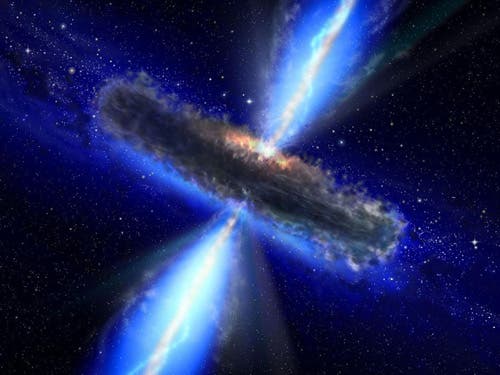
Atronomers have found the biggest waterway so far known, a store of water drifting in A space around an antiquated far off quasar, holding 140 trillion times the mass of water in the Earth's oceans.Remarkably enough, the find was dated as being 12 billion light years away, just 1.6 billion light years more remote from the Big Bang.
"Since cosmologists anticipated that water vapor would be available even in the early universe, the revelation of water is not itself a shock," said the Carnegie Institution in explanation, one of the gatherings behind the discoveries, said.
The water cloud was observed to be in the focal areas of a faraway quasar.
"Quasars contain enormous dark openings that consistently expending an encompassing circle of gas and tidy; as it eats, the quasar retches out measures of vitality," the Institution proceeded in its announcement.
What's more, a considerable measure of it, I may include. Quasars are the most effective known elements in space, with this specific one directing out 1,000 trillion times more vitality than our sun, and 65,000 times the entire of the Milky Way. The dark opening found at the quasar's middle has a mass 20 billion times more noteworthy than the sun.
NASA researcher Matt Bradford has stated, "the earth around this quasar is extremely one of a kind in that it's delivering this tremendous mass of water. It's another exhibit that water is unavoidable all through the universe, even at the most punctual circumstances."
RELATED: Most removed quasar in the known Universe found
While water vapors are known to be found all through the Universe, it isn't so much that basic of a sight. In the Milky Way, water vapor surfaces are discovered just specifically locales a couple light years crosswise over at most, in any case, the water in the inaccessible quasar seems, by all accounts, to be spread more than many light years.
The find came as a feature of a quasar contemplate called "APM 08279+5255", which accumulated on perceptions initially initiated by NASA three years back in 2008, made utilizing an instrument called "Z-Spec" at the California Institute of Technology's Submillimeter Observatory. The instrument is a 33-foot (10-meter) telescope close to the summit of Mauna Kea in Hawaii.
"Achievements are coming quick in millimeter and submillimeter innovation, empowering us to study old universes gotten in the demonstration of framing stars and supermassive dark openings," says CU-Boulder relate teacher Jason Glenn.

No comments:
Post a Comment